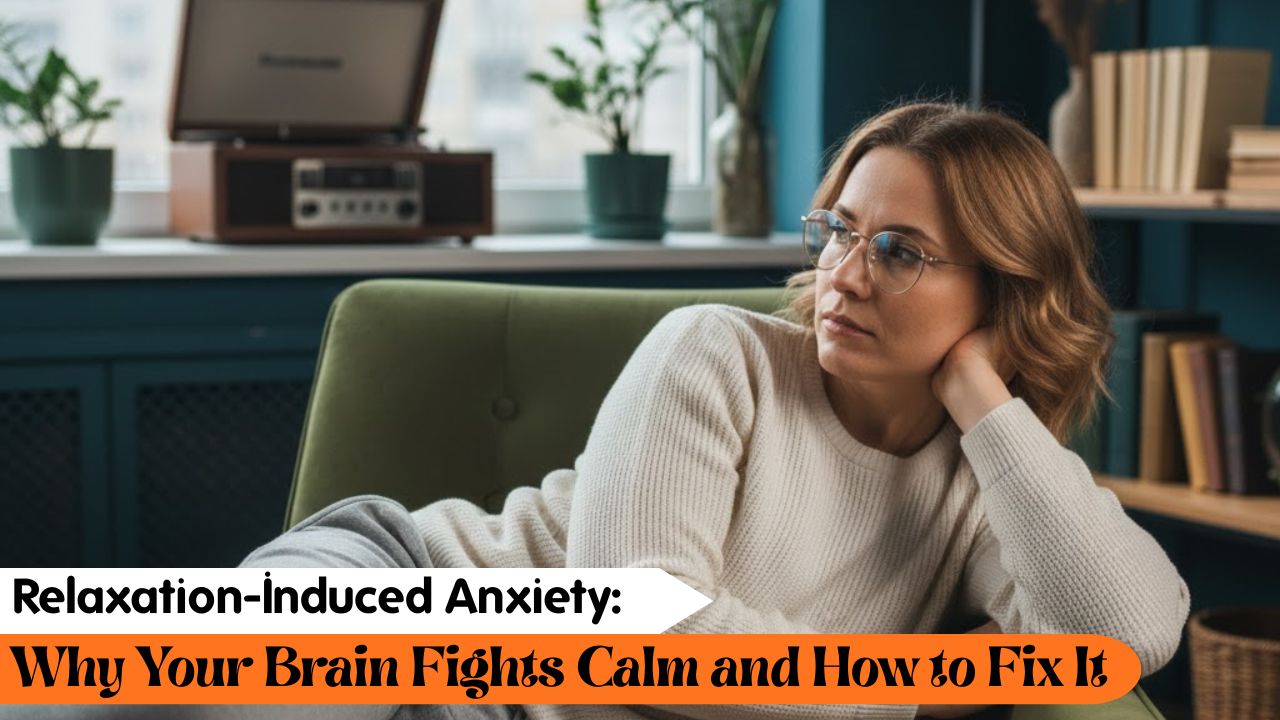
Relaxation-Induced Anxiety: Why Your Brain Fights Calm and How to Fix It
Introduction:
Why do some relaxation techniques increase anxiety? The culprit is Relaxation-Induced Anxiety (RIA), a physiological rebound effect. When you reduce external stimulation, your Sympathetic Nervous System may remain hypervigilant. For high-stress individuals or trauma survivors, the sudden shift from a high-arousal state to stillness triggers a fight-or-flight response.
The fix is the Active-to-Passive Bridge: start with active relaxation (walking, yoga, tai chi) to metabolize stress hormones like cortisol and adrenaline, then transition to passive relaxation (body scans, meditation) to safely engage the parasympathetic nervous system. Meditation is a form of interoceptive exposure, which some nervous systems aren’t yet regulated enough to tolerate safely.
Clinical studies, including research published in Cognitive Behaviour Therapy, indicate that 17–31% of people report an increase in anxiety symptoms when practicing relaxation—nearly one in three high-stress individuals.
Understanding the Science of Relaxation-Induced Anxiety
 Stress-Accumulation-How-Small-Stressors-Add-Up-1-1024x576.jpg" alt="Current image: Relaxation-Induced Anxiety: Why Your Brain Fights Calm and How to Fix It" title="Relaxation-Induced Anxiety: Why Your Brain Fights Calm and How to Fix It 2">
You are not failing. Your body is responding to chronic stress. Neuroplasticity has wired your nervous system so that high-arousal states feel “normal.” Attempting stillness outside your window of tolerance triggers a physiological rebound into hyper-arousal.
Common Symptoms of RIA (Symptom Mirroring)
- Air hunger: sensation of not getting a deep breath
- Inner vibrating or trembling limbs
- Sudden intrusive thoughts
- Urge to bolt or leave the room
- Racing heartbeat or fluttering chest
- Heightened sensory awareness
Clinical Insight: Recognizing these symptoms validates your experience. They are your nervous system’s way of saying, “I’m not ready to fully relax yet.”
This YouTube video below by Barbara Heffernan explains relaxation induced anxiety and why calm techniques can sometimes trigger distress. She explores underlying cognitive and nervous system responses. This reference supports understanding paradoxical anxiety reactions during relaxation practices.
Contrast Table: Traditional vs Trauma-Informed Relaxation
| Trigger (Traditional) | Safe Alternative (Active/Trauma-Informed) |
|---|---|
| Sitting silently, eyes closed | Walking meditation |
| Focusing exclusively on breath | Soft-gaze grounding |
| Internal counting or mantra | Rhythmic humming / “Voo” breathing |
The Biological “Why”: Window of Tolerance & Hypervigilance
The Autonomic Nervous System (ANS) has a window of tolerance, the zone where stress is manageable. Chronic stress raises your baseline—high-arousal states become your homeostasis.
Attempting meditation or deep breathing when hyper-aroused pulls you outside your window of tolerance. The body interprets the sudden stillness as a threat, causing cortisol and adrenaline spikes.
The Anterior Cingulate Cortex (ACC) & Internal Monitoring
The ACC, your brain’s “error detection” center, monitors both external and internal stimuli. When external noise drops, the ACC turns full attention inward. Slight physiological fluctuations, like an elevated heart rate, may be misinterpreted as a hidden threat, creating a self-reinforcing hypervigilance loop.
Interoceptive Exposure Explained
Definition Box: Interoception is your brain’s ability to sense internal states—heartbeat, breath, digestion. For those with RIA, high interoceptive awareness acts like a magnifying glass on stress, making normal fluctuations feel like emergencies. Meditation is effectively interoceptive exposure, which some nervous systems aren’t ready to tolerate.
Top 3 Reasons Meditation Backfires
- Loss of Control
Stillness can feel vulnerable. In Western “hustle culture,” the brain often equates stillness with laziness or lost time. This Productivity Guilt acts as a subconscious stressor, preventing full nervous system de-escalation. - Hyper-Awareness (Interoception)
Focus on breath or heartbeat magnifies normal sensations, triggering anxiety loops. - Silence of Subconscious Thoughts
Without external distractions, unresolved worries surface, reinforcing internal stress signals.
Pro-Tip: Track body sensations without judgment. Awareness is different from analysis.
Sarah’s Story: A Case Study in Autonomic Rebound
Sarah, a marketing executive in Chicago, tried meditating after a 10-hour day. Sitting cross-legged, she focused on her breath. Soon, her heart raced, palms sweated, and thoughts spiraled.
For Sarah, traditional meditation triggered her hyper-arousal loop. Using the Active-to-Passive Bridge, she replaced the cushion with 5 minutes of wall pushes, discharging excess adrenaline and preparing her nervous system for safe stillness.
The 3-Step Reset: Moving from Arousal to Actual Calm
Step 1: Discharge Adrenaline
Engage large muscle groups to metabolize stress energy. Options: wall pushes, squats, arm swings. Sarah’s body now recognizes that threat energy has a physical outlet.
Step 2: Orient to the Environment (Micro-Instruction)
Keep eyes open. Identify three blue objects in the room. This shifts neural activity from amygdala (fear center) to prefrontal cortex (rational center).
Step 3: Rhythmic Movement & Physiological Sigh
Use somatic shaking, gentle bouncing, or rhythmic humming. Then practice the Physiological Sigh: double inhale through the nose, long slow exhale through the mouth. This triggers the diaphragm’s release, offloads CO₂, and engages the sigh reflex—the fastest biological reset for calm.
Step 4: Transition to Passive
Once tension is discharged, engage in body scan or guided meditation. Now the parasympathetic nervous system can safely restore homeostasis.
Common Myths: RIA vs. Panic Attacks
- RIA is not a panic attack: No persistent fear of dying; symptoms are temporary.
- Heart palpitations and shortness of breath may occur in both, but RIA resolves when the Active-to-Passive bridge is applied.
- RIA differs from clinical anxiety: triggered by attempted relaxation, not constant stress baseline.
Clinical Indicators: When RIA Requires Professional Somatic Therapy
Seek professional help if:
- Anxiety persists despite repeated Active-to-Passive routines
- Panic attacks increase in frequency or intensity
- History of PTSD, trauma, or GAD
Therapists trained in MBSR and trauma-informed somatic therapy can integrate active movement with mindfulness safely.
Redefining Calm: Measurable Success Metrics
You’ll know the Active-to-Passive bridge is working when:
- Your sigh reflex triggers spontaneously
- Heart rate and muscle tension decrease noticeably
- Mental clarity returns without external distractions
Practical Call to Action:
Next time relaxation sparks anxiety, stand up, move, and engage your body first. Your nervous system isn’t broken—it’s asking for a physiological bridge to true calm.
Conclusion: Master Calm with the Active-to-Passive Bridge
Relaxation is a skill, not a switch. Attempting stillness too soon can trigger RIA, but starting with active movement helps discharge stress and prepares the nervous system for safe calm. The Active-to-Passive Bridge makes relaxation measurable: look for your sigh reflex, loosened muscles, and restored mental clarity.
Try a simple 10-minute routine today—5 minutes of gentle movement, 2 minutes of environmental orientation, 3 minutes of mindful breathing. With consistent practice, you retrain your brain and body to respond to stress with real calm, even in a high-pressure, productivity-driven culture.