Dr. Elizabeth Vance, PsyD, LCSW
🛡️ Verified ClinicianLicensed Clinical Psychologist & Psychotherapist
Dr. Vance is a licensed clinical psychologist and somatic therapy pioneer with over 14 years of clinical outpatient experience. She specializes in cognitive behavioral therapy (CBT), somatic down-regulation techniques, and values-based emotional regulation frameworks.
A relaxing bedtime routine is not simply a collection of pleasant evening habits. It is a scientifically grounded neurological signal system that communicates to your brain and body that the time for rest, restoration, and deep sleep has arrived.
In a world characterized by constant digital stimulation, relentless productivity pressure, and chronic stress, most adults have inadvertently trained their nervous systems to remain in a state of high alert well into the night, making genuinely restorative sleep feel increasingly elusive. The solution is not stronger sleep medication or forcing yourself to feel tired earlier.
It is the deliberate, consistent construction of a relaxing bedtime routine that works with your biology rather than against it. In this comprehensive guide, we explore the neuroscience of sleep preparation, the most evidence-based evening practices, and exactly how to build a personalized relaxing bedtime routine that genuinely transforms your sleep quality and mental health.

Why a Relaxing Bedtime Routine Is a Mental Health Necessity
Sleep is not passive. During sleep, your brain performs critical maintenance functions that are impossible to replicate during waking hours. These include:
- Glymphatic clearance: The brain’s waste-removal system activates primarily during deep sleep, flushing out metabolic byproducts including amyloid beta proteins linked to Alzheimer’s disease
- Memory consolidation: The hippocampus transfers newly acquired information into long-term cortical storage during REM sleep
- Emotional processing: The prefrontal cortex and amygdala reprocess emotionally charged experiences during sleep, reducing their psychological intensity
- Hormonal regulation: Growth hormone, cortisol, melatonin, and leptin are all regulated through sleep-dependent cycles
- Immune system strengthening: Cytokine production and immune cell activity peak during deep sleep phases
When these processes are disrupted by poor sleep quality, the consequences extend far beyond next-day fatigue. Chronic sleep deprivation is directly linked to increased anxiety and depression, impaired cognitive function, weakened immune response, metabolic dysregulation, cardiovascular disease risk, and significantly reduced Emotional Resilience" class="glossary-internal-link">emotional resilience.
A consistent relaxing bedtime routine directly supports all of these biological processes by optimizing the conditions for deep, restorative sleep.
This YouTube video below explains the role of sleep in mental health, highlighting how sleep affects mood, stress, and brain function. It shows why good sleep is essential for emotional well-being. Understanding this helps improve both sleep and mental health.
The Neuroscience of Sleep Onset
Understanding why a relaxing bedtime routine works requires basic familiarity with your brain’s sleep-wake regulation systems.
Circadian rhythm is your internal 24-hour biological clock, governed primarily by the suprachiasmatic nucleus (SCN) in the hypothalamus. This system regulates the timing of melatonin release from the pineal gland, body temperature fluctuation, and dozens of other physiological rhythms that collectively orchestrate the sleep-wake cycle.
Sleep pressure (adenosine accumulation) is the second major sleep regulation system. Adenosine, a sleep-promoting chemical, accumulates in the brain throughout the day, creating progressively increasing sleep drive that peaks in the evening. Caffeine works by blocking adenosine receptors, artificially suppressing this natural sleep pressure.
A well-designed relaxing bedtime routine works by aligning your behaviors with both systems, supporting natural melatonin release, reducing physiological arousal, and creating consistent temporal cues that train your circadian rhythm to anticipate sleep at the same time each night.
The 10 Most Powerful Elements of a Relaxing Bedtime Routine
1. Establish a Consistent Sleep-Wake Schedule
The foundation of any effective relaxing bedtime routine is temporal consistency. Going to bed and waking at approximately the same time every day, including weekends, is the single most powerful thing you can do to strengthen your circadian rhythm and improve sleep quality.
Research from the American Academy of Sleep Medicine consistently demonstrates that irregular sleep schedules produce circadian misalignment equivalent to regular transmeridian travel, chronically disrupting sleep architecture and daytime functioning.
Begin your relaxing bedtime routine at the same time each evening, ideally 60 to 90 minutes before your target sleep time, to give your biology adequate preparation time.
2. Implement a Digital Sunset at Least One Hour Before Bed
Blue light emitted by smartphones, tablets, laptops, and televisions directly suppresses melatonin production by signaling to the SCN that it is still daytime. Research from Harvard Medical School demonstrates that blue light exposure in the evening delays melatonin onset by up to three hours, significantly disrupting both sleep onset and sleep architecture.
A genuine relaxing bedtime routine requires a meaningful digital sunset: putting away screens at least 60 minutes before bed. If complete avoidance is not possible, blue light blocking glasses and enabling night mode settings reduce but do not eliminate the melatonin-suppressing effect.
Replace screen time with activities that naturally support a relaxing bedtime routine, including reading physical books, journaling, gentle conversation, or the other practices outlined below.
3. Optimize Your Sleep Environment
Your bedroom environment powerfully influences whether your relaxing bedtime routine successfully bridges into deep, sustained sleep. Research-supported environmental optimization includes:
- Temperature: The ideal bedroom temperature for sleep onset is 65 to 68 degrees Fahrenheit (18 to 20 degrees Celsius). Core body temperature drops approximately 1 to 2 degrees as part of natural sleep onset, and a cool room facilitates this essential thermoregulatory process.
- Darkness: Complete darkness maximizes melatonin production. Use blackout curtains or a sleep mask to eliminate light pollution from streetlights, electronics, and early morning sun.
- Sound management: Silence is ideal, but consistent background sound such as white noise, pink noise, or nature sounds effectively masks disruptive environmental noise for many sleepers.
- Bed association: Your brain should associate your bed exclusively with sleep and intimacy. Avoid working, watching television, or eating in bed, as these activities train the brain to associate the sleep environment with wakefulness.
4. Practice Progressive Muscle Relaxation
Progressive muscle relaxation (PMR) is a clinically validated technique that systematically reduces physiological tension accumulated throughout the day, making it an ideal component of a relaxing bedtime routine. PMR involves deliberately tensing specific muscle groups for five to ten seconds and then releasing them completely, working progressively through the body from feet to face.
The mechanism is twofold. The deliberate tension phase creates heightened awareness of where you are holding stress in your body. The release phase activates the parasympathetic nervous system and produces a profound contrast-based relaxation response that deepens with each muscle group addressed.
Research published in the Journal of Behavioral Medicine demonstrates that regular PMR practice significantly reduces sleep onset latency (the time required to fall asleep) and improves subjective sleep quality in individuals with chronic insomnia.
5. Incorporate a Warm Bath or Shower
A warm bath or shower approximately 60 to 90 minutes before sleep is one of the most elegantly simple additions to a relaxing bedtime routine, with robust research support. A study published in Sleep Medicine Reviews found that bathing in water between 104 and 109 degrees Fahrenheit in the evening accelerated sleep onset by an average of ten minutes and improved slow-wave deep sleep quality.
The mechanism involves peripheral vasodilation. Warm water draws blood to the skin’s surface, accelerating heat dissipation and producing the core body temperature drop that signals the brain to initiate sleep. The contrast between the warm bath and subsequent cool bedroom environment amplifies this sleep-promoting thermoregulatory signal.
6. Practice Mindfulness Meditation or Body Scan
Mindfulness meditation is among the most extensively researched interventions for sleep disturbance, with a 2019 meta-analysis in Annals of the New York Academy of Sciences finding significant improvements in sleep quality, sleep onset latency, and total sleep duration among regular meditators.
Incorporating mindfulness into your relaxing bedtime routine does not require lengthy or complex practice. A simple body scan meditation of ten to twenty minutes, involving a gradual, non-judgmental awareness sweep from feet to crown, systematically releases physical tension and redirects attention from anxious future-focused thinking toward present-moment sensory experience.
This attentional shift is particularly valuable for individuals whose sleep is disrupted by racing thoughts, worry, and rumination, as it interrupts the cognitive arousal cycle that prevents sleep onset.
This YouTube video below explains body scan meditation, highlighting a mindfulness technique that guides awareness through different parts of the body. It shows how this practice reduces stress and improves relaxation. Understanding this helps support mental well-being and focus.
7. Use Diaphragmatic Breathing Techniques
Specific breathing patterns are among the most immediately effective tools within a relaxing bedtime routine because they directly activate the parasympathetic nervous system through the Grounding Exercises" class="glossary-internal-link">vagus nerve, shifting the body from sympathetic fight-or-flight dominance toward the rest-and-digest state conducive to sleep.
Evidence-based breathing techniques for your relaxing bedtime routine include:
- 4-7-8 breathing: Inhale for 4 counts, hold for 7 counts, exhale completely for 8 counts. The extended exhale activates the parasympathetic response and reduces heart rate almost immediately.
- Box breathing: Inhale for 4 counts, hold for 4 counts, exhale for 4 counts, hold for 4 counts. Particularly effective for anxiety-related sleep disruption.
- Physiological sigh: A double inhale through the nose followed by a long extended exhale. Stanford neuroscientist Dr. Andrew Huberman’s research identifies this as the fastest way to reduce acute physiological stress activation.
Practicing any of these techniques for five to ten minutes as part of your relaxing bedtime routine creates a measurable shift in autonomic nervous system balance that significantly facilitates sleep onset.
8. Journal to Offload Cognitive Arousal
One of the primary enemies of sleep is an overactive mind rehearsing tomorrow’s concerns, replaying today’s regrets, and generating an endless stream of unresolved cognitive loops. Journaling within your relaxing bedtime routine provides a structured external container for these mental contents, allowing your mind to genuinely release them rather than cycling through them repeatedly.
Research published in the Journal of Experimental Psychology found that writing a specific to-do list for the following day for just five minutes before bed significantly accelerated sleep onset, with more specific lists producing stronger effects. The act of externalizing planned tasks appears to signal the brain that these concerns have been registered and can safely be deactivated until tomorrow.
A comprehensive relaxing bedtime routine journal practice might include:
- Brain dump: Write every unresolved thought, concern, or pending task without editing or organizing
- Gratitude reflection: Three to five specific things you genuinely appreciated about the day, which activates positive affect and counters anxiety-promoting cognitive patterns
- Tomorrow’s intentions: A brief, specific list of priorities for the following day
- Emotional processing: A few sentences about how you are feeling and why, releasing emotional charge before sleep
9. Read Fiction or Engage in Calming Analog Activities
Reading physical books, particularly fiction, is a highly effective relaxing bedtime routine activity that serves multiple sleep-supportive functions simultaneously. It displaces screen exposure, provides gentle cognitive engagement that prevents anxious rumination without producing arousal, and supports the gradual transition from alert wakefulness toward sleepiness.
A 2009 study from the University of Sussex found that reading for just six minutes reduced physiological stress markers by 68 percent, outperforming listening to music, taking a walk, or drinking tea as a stress reduction intervention.
Other analog activities that support a relaxing bedtime routine include:
- Gentle stretching or restorative yoga poses
- Listening to calming music or sleep-specific playlists
- Light craft activities such as knitting or drawing
- Herbal tea rituals using chamomile, valerian root, or passionflower
10. Use Aromatherapy and Sensory Cues
Sensory cues can become powerful conditioned signals within your relaxing bedtime routine. The olfactory system has a uniquely direct neural pathway to the limbic system, which governs emotional processing and stress response, making scent one of the most immediate ways to shift physiological state.
Lavender essential oil has the most robust research evidence for sleep support among aromatherapy options. Studies demonstrate that lavender aromatherapy reduces anxiety, slows heart rate, and improves subjective sleep quality. Diffusing lavender in your bedroom during your relaxing bedtime routine, or applying a diluted blend to your pillow, can become a powerful conditioned sleep cue over time.
Other evidence-supported sleep-promoting scents include bergamot, cedarwood, Roman chamomile, and sandalwood.
Building Your Personalized Relaxing Bedtime Routine – A Sample Schedule
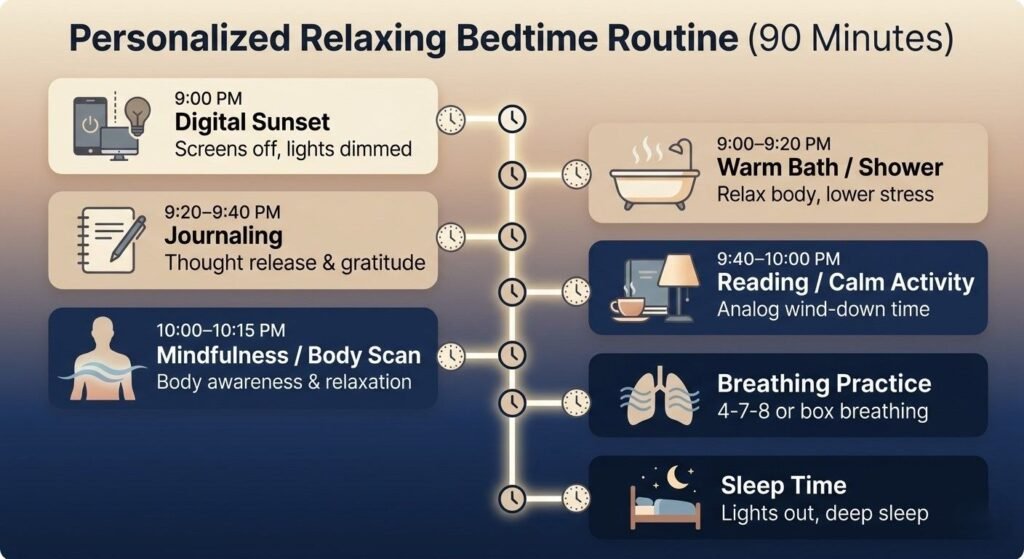
Here is an example of how these elements might be woven into a cohesive 90-minute relaxing bedtime routine:
9:00 PM — Digital Sunset
All screens off. Dim household lighting to signal the brain that evening has arrived.
9:00–9:20 PM — Warm Bath or Shower
60 to 90 minutes before target sleep time for optimal thermoregulatory benefit.
9:20–9:40 PM — Journaling
Brain dump, gratitude reflection, and tomorrow’s brief to-do list.
9:40–10:00 PM — Reading or Calming Analog Activity
Physical book, gentle stretching, or herbal tea ritual with aromatherapy diffusing.
10:00–10:15 PM — Mindfulness or Body Scan Meditation
Ten to fifteen minutes of guided or independent body scan practice.
10:15–10:25 PM — Breathing Practice
Five to ten minutes of 4-7-8 breathing or box breathing in bed.
10:30 PM — Target Sleep Time
Lights out, cool dark room, consistent nightly timing.
Common Mistakes That Undermine a Relaxing Bedtime Routine
Even well-intentioned sleep practices can be undermined by common errors:
- Inconsistent timing: Maintaining the routine on weekdays but abandoning it on weekends disrupts the circadian conditioning that makes the routine effective
- Alcohol as a sleep aid: While alcohol initially produces drowsiness, it severely disrupts REM sleep architecture in the second half of the night, producing fragmented, unrestorative sleep
- Late caffeine consumption: Caffeine’s half-life is approximately five to seven hours, meaning afternoon coffee consumption still significantly suppresses adenosine-driven sleep pressure by bedtime
- Clock-watching: Checking the time during sleep difficulty amplifies performance anxiety and arousal, worsening insomnia
- Excessive time in bed while awake: Paradoxically, spending more time in bed to compensate for poor sleep weakens sleep drive and deepens insomnia patterns
When Sleep Problems Require Professional Support
A consistent relaxing bedtime routine resolves mild to moderate sleep difficulties for the majority of people who practice it faithfully. However, some sleep disturbances require professional clinical assessment and intervention:
- Chronic insomnia disorder: Difficulty initiating or maintaining sleep occurring at least three nights per week for more than three months
- Sleep apnea: Characterized by snoring, gasping, and non-restorative sleep despite adequate sleep duration
- Restless legs syndrome: Uncomfortable sensations creating an irresistible urge to move the legs during sleep
- Circadian rhythm disorders: Persistent misalignment between desired and actual sleep timing
- Sleep disturbances linked to anxiety, depression, or PTSD
Cognitive Behavioral Therapy for Insomnia (CBT-I) is the gold-standard, first-line treatment for chronic insomnia, consistently outperforming sleep medication in both short-term and long-term outcome research. A therapist specializing in behavioral sleep medicine can provide CBT-I alongside supporting your development of an effective relaxing bedtime routine.
Final Thoughts
A thoughtfully constructed relaxing bedtime routine is one of the highest-return investments you can make in your mental health, cognitive performance, emotional resilience, and overall quality of life. Sleep is not a passive state you fall into when exhausted enough. It is an active biological process that requires deliberate preparation, environmental optimization, and consistent behavioral signaling to occur in its most restorative form.
Begin tonight. Choose two or three elements from this guide, practice them consistently for two weeks, and build gradually from there. Your relaxing bedtime routine does not need to be perfect from the start. It simply needs to begin, and then be honored with the same consistency you would give any other non-negotiable health practice.
Your best sleep, and everything that flows from it, is closer than you think.