Dr. Elizabeth Vance, PsyD, LCSW
🛡️ Verified ClinicianLicensed Clinical Psychologist & Psychotherapist
Dr. Vance is a licensed clinical psychologist and somatic therapy pioneer with over 14 years of clinical outpatient experience. She specializes in cognitive behavioral therapy (CBT), somatic down-regulation techniques, and values-based emotional regulation frameworks.
Emotional vs cognitive anxiety is a distinction that most people living with anxiety have never been taught, yet understanding it may be the single most important factor in determining why certain anxiety treatments work brilliantly for some people while producing minimal results for others.
Picture yourself sitting in a Monday morning work meeting. Your mind races through every possible mistake you might make, replaying past errors and rehearsing catastrophic future scenarios. Or alternatively, your chest tightens, your stomach churns, your palms sweat, and your heart pounds before you have even consciously registered that you feel worried about anything at all. Both experiences are anxiety. Both cause genuine suffering.
But they begin in entirely different neurobiological locations, travel through different neural pathways, and respond most effectively to different therapeutic interventions. Mastering the emotional vs cognitive anxiety distinction transforms anxiety treatment from guesswork into a precision-guided clinical strategy.
 Anxiety: How to Tell the Difference & Find Relief" title="Emotional vs Cognitive Anxiety: How to Tell the Difference & Find Relief 2">
Why the Emotional vs Cognitive Anxiety Distinction Matters Clinically
Before exploring each anxiety subtype in depth, it is important to understand why this distinction carries such significant clinical weight.
According to the National Institute of Mental Health (NIMH), anxiety disorders affect approximately 19.1 percent of American adults annually, making them the most prevalent category of mental health conditions in the country. Despite this prevalence, treatment response rates remain inconsistently high, with a substantial percentage of anxiety sufferers cycling through multiple treatments before finding meaningful relief.
A significant contributor to this inconsistency is treatment mismatching. Cognitive behavioral therapy (CBT) is the most widely prescribed psychological treatment for anxiety, and it produces excellent outcomes for cognitively dominant anxiety presentations. However, for individuals whose anxiety is primarily somatic and emotionally driven, pure cognitive interventions consistently underperform because they target the wrong end of the anxiety system.
Understanding emotional vs cognitive anxiety is not merely an academic distinction. It is a practical clinical framework that directly determines which interventions will produce genuine, lasting relief for your specific anxiety presentation.
Understanding Cognitive Anxiety: The Mind Loop
Cognitive anxiety is a top-down process, meaning it originates in the higher cortical thinking centers of the brain and travels downward, eventually producing physiological arousal as a secondary consequence of prolonged mental activation.
The Neurobiological Architecture of Cognitive Anxiety
Cognitive anxiety is primarily generated and maintained by two interconnected brain systems:
The Prefrontal Cortex (PFC): The brain’s executive center, responsible for planning, decision-making, self-monitoring, and future projection. In cognitive anxiety, the PFC becomes hyperactive in its predictive and evaluative functions, generating an endless stream of threat assessments, worst-case scenario projections, and self-critical evaluations that cycle continuously without resolution.
The Default Mode Network (DMN): A network of brain regions including the medial prefrontal cortex, posterior cingulate cortex, and angular gyrus that activates during mind-wandering, self-referential thinking, and rumination. Research consistently demonstrates that anxious individuals show elevated DMN activity, correlating with the ruminative, repetitive thought patterns that characterize cognitive anxiety.
The result is what clinicians describe as the cognitive anxiety “what-if loop”: an automated cycle of threat prediction, outcome catastrophizing, and uncertainty intolerance that the thinking brain generates and maintains independently of any actual external threat.
Metacognitive Anxiety: Worrying About Worrying
One of the most important concepts in understanding cognitive anxiety is metacognitive anxiety, the experience of worrying about the process of worrying itself. Metacognitive anxiety creates a second-order anxiety loop:
- First-order worry: “What if I fail this presentation?”
- Metacognitive worry: “Why can’t I stop worrying? Something must be seriously wrong with me. My worry itself is dangerous.”
This second loop dramatically amplifies cognitive anxiety because it adds shame, self-criticism, and existential threat to the already-active worry content.
Thought-fusion is the closely related phenomenon where anxious thoughts are treated as literal truths rather than recognized as mental events. When someone experiencing cognitive anxiety has the thought “I will certainly fail,” they experience this as factual information rather than as one possible cognitive interpretation among many. Thought-fusion is a primary maintenance mechanism of cognitive anxiety and a primary target of mindfulness and ACT-based interventions.
The High-Achiever Cognitive Anxiety Trap
Cognitive anxiety has a particular affinity for high-achieving individuals in demanding professional environments. The relentless mental rehearsal, perfectionism, over-preparation, and catastrophic failure-anticipation that characterize cognitive anxiety can superficially resemble conscientiousness, diligence, and professional dedication.
This masking phenomenon creates a dangerous feedback loop. The individual receives external validation for anxiety-driven behaviors (promotions, praise, high performance ratings) while the underlying anxiety intensifies, ultimately producing burnout, chronic sleep disruption, relationship deterioration, and cognitive exhaustion.
Core Symptoms of Cognitive Anxiety
- Racing, repetitive thoughts that feel impossible to stop or redirect
- Persistent rumination about past events and decisions
- Chronic future-focused worry and catastrophic predictions
- Profound difficulty making decisions due to hyperanalysis
- Sleep-onset insomnia driven by mental chatter and thought loops
- Brain fog and cognitive fatigue from sustained mental hyperactivation
- Perfectionism and intolerance of uncertainty
- Mental rehearsal of worst-case scenarios
- Excessive self-monitoring and self-critical evaluation
Understanding Emotional and Somatic Anxiety: The Body Loop
In the emotional vs cognitive anxiety framework, emotional anxiety represents the opposite pathway. It is a bottom-up process, originating in subcortical brain structures and the body’s physiological systems before the thinking brain registers any conscious worry.
The Neurobiological Architecture of Emotional Anxiety
Emotional anxiety is primarily driven by:
The Amygdala: The brain’s primary threat-detection and emotional alarm center. In emotional anxiety, the amygdala fires in response to internal or external cues before conscious threat appraisal has occurred, producing immediate physiological activation that precedes and often operates independently of cognitive anxiety content.
The Autonomic Nervous System (ANS): The amygdala’s alarm signal travels through the ANS, activating the sympathetic branch and producing the characteristic physiological signature of emotional anxiety: accelerated heart rate, shallow breathing, muscle tension, digestive disruption, and sweating.
The HPA Axis: The hypothalamic-pituitary-adrenal axis orchestrates the stress hormone cascade, releasing cortisol and adrenaline that sustain physiological arousal long after the initial amygdala alarm, explaining why emotional anxiety can feel relentless even when no identifiable cognitive trigger is present.
The Insular Cortex: This brain region interprets afferent signals traveling upward from the body to the brain, translating physiological arousal into the subjective feeling of anxiety. In individuals with predominantly emotional anxiety, the insular cortex demonstrates heightened sensitivity to bodily signals, amplifying physiological arousal into intensely distressing emotional experiences.
The Somatic Marker Hypothesis
Neurologist Antonio Damasio’s influential somatic marker hypothesis proposes that the brain uses bodily states as informational signals, somatic markers, to guide decision-making and emotional evaluation. In emotional anxiety, these somatic markers overfire in response to neutral or ambiguous situations, flooding the system with threat-associated physiological signals that generate anxiety from the body upward before the thinking mind has any opportunity to evaluate the actual threat level.
This bottom-up process explains why emotional anxiety often feels profoundly irrational. The person experiencing it can acknowledge cognitively that there is no genuine danger, yet their body continues producing intense physiological anxiety signals regardless.
The Bidirectional Anxiety Highway: Interoception
Understanding emotional vs cognitive anxiety fully requires appreciating that these are not completely separate systems. Anxiety operates through a bidirectional mind-body feedback loop:
Efferent pathways carry signals from the brain downward to the body, producing physiological stress responses. This is the cognitive anxiety pathway: worried thoughts activate the amygdala, which activates the sympathetic nervous system, which produces physical symptoms.
Afferent pathways carry signals from the body upward to the brain, where the insular cortex interprets them. This is the emotional anxiety pathway: physiological arousal signals travel upward and are interpreted as anxiety, producing cognitive anxiety content as a secondary response.
This bidirectional loop explains why the emotional vs cognitive anxiety distinction, while clinically important, involves two aspects of a unified system rather than completely separate disorders. It also explains why purely cognitive interventions fail to resolve somatic anxiety: they target the efferent pathway while the afferent pathway continues generating upward-traveling arousal signals that reinstate anxiety regardless of how thoroughly thoughts are challenged.
Core Symptoms of Emotional and Somatic Anxiety
- Rapid, pounding heartbeat and palpitations occurring without identifiable cognitive trigger
- Shallow, constricted breathing and air hunger
- Digestive disruption including nausea, stomach cramping, and irritable bowel symptoms
- Trembling, muscle tension, and physical restlessness
- Sweating, flushing, and temperature dysregulation
- Chest tightness and pressure
- Dizziness and lightheadedness
- Sleep-onset insomnia driven by physiological hyperarousal blocking melatonin production
- Feeling physically threatened without being able to identify why
- Physical symptoms that precede and occur independently of anxious thoughts
How to Identify Your Dominant Anxiety Type: The Differential Assessment
Accurately distinguishing emotional vs cognitive anxiety in your own experience is the clinical foundation of effective self-directed treatment. This structured self-assessment helps clarify your dominant anxiety presentation.
The Three-Step Experiential Test
Step 1: Find a quiet moment when you are experiencing anxiety of at least moderate intensity. Close your eyes and spend sixty seconds simply observing your internal experience without attempting to change anything.
Step 2: Bring deliberate attention to the sequence of your anxiety experience. Ask honestly: Did the anxiety begin with identifiable thoughts, worries, or mental content? Or did it begin with physical sensations, bodily tension, or physiological arousal that preceded any conscious thoughts?
Step 3: Conduct a targeted isolation experiment:
- Calm your body using slow deep breathing and progressive muscle relaxation for five minutes. If intrusive anxious thoughts persist despite physiological calming, cognitive anxiety is dominant.
- Challenge and reframe your anxious thoughts using cognitive restructuring for five minutes. If physical arousal symptoms persist despite cognitive calming, emotional anxiety is dominant.
- If both dimensions respond to their respective interventions, you likely have a mixed presentation requiring integrated treatment targeting both pathways.
Planning vs Worrying: A Clinical Distinction
One of the most practically useful aspects of understanding emotional vs cognitive anxiety is distinguishing productive planning from anxiety-driven worry. This distinction clarifies whether cognitive anxiety is generating false urgency.
| Mental Activity | Focus | Neurochemical Driver | Physical Result |
|---|---|---|---|
| Productive planning | Action-oriented, concrete next steps | Dopamine | Decreased tension, sense of readiness |
| Cognitive worry | Emotion-focused, imagined failure | Epinephrine, norepinephrine | Increased cortisol, exhaustion |
| Rumination | Hypothetical scenarios without solutions | Glutamate | Emotional depletion, mental fatigue |
The Five-Minute Reality Check for Cognitive Anxiety:
When cognitive worry activates, ask: “Is the event I am worrying about more than five minutes away? Can I take any concrete action right now?” If no immediate action is available, deliberately engage a Task-Positive Network (TPN) activity, such as a complex puzzle, backward counting, or physical exercise, to interrupt the Default Mode Network rumination cycle and redirect neural resources toward present-moment engagement.
Treatment Matching: Why One-Size-Fits-All Fails the Emotional vs Cognitive Anxiety Distinction
The most important clinical implication of understanding emotional vs cognitive anxiety is recognizing that treatment must be matched to the dominant anxiety pathway for optimal effectiveness.
Evidence-Based Treatments for Cognitive Anxiety
Cognitive Behavioral Therapy (CBT):
CBT is the gold-standard treatment for cognitively dominant anxiety because it directly targets the distorted thought patterns, unhelpful beliefs, and catastrophic predictions that generate and maintain cognitive anxiety. Core CBT techniques including thought records, cognitive restructuring, Socratic questioning, and behavioral experiments systematically dismantle the cognitive architecture of anxiety from the top down.
Metacognitive Therapy (MCT):
Specifically designed to address the metacognitive beliefs driving second-order worry (worrying about worrying), MCT has demonstrated superiority to standard CBT for generalized anxiety disorder in several randomized controlled trials. MCT targets the beliefs that make worry seem both necessary and dangerous simultaneously.
Scheduled Worry Time:
This CBT technique constrains cognitive anxiety by creating a specific, bounded daily period (typically 15 to 20 minutes) designated for worry engagement. All other worry that arises throughout the day is acknowledged and deliberately postponed to the scheduled worry time. This practice reduces cognitive anxiety’s colonization of all waking hours.
Mindfulness-Based Cognitive Therapy (MBCT):
MBCT reduces cognitive anxiety by training the observational capacity to recognize anxious thoughts as mental events rather than literal truths, directly addressing thought-fusion and reducing Default Mode Network hyperactivity through consistent mindfulness practice.
Acceptance and Commitment Therapy (ACT):
ACT builds psychological flexibility, the capacity to hold anxious thoughts with non-fused, non-attached awareness while committing to values-aligned action regardless of what cognitive anxiety generates. ACT is particularly effective for chronic cognitive anxiety in high-achieving individuals because it does not demand that worry stop, only that it lose its behavioral control.
Evidence-Based Treatments for Emotional and Somatic Anxiety
Somatic Experiencing (SE):
Developed by Dr. Peter Levine, Somatic Experiencing directly addresses the body-held physiological patterns of emotional anxiety by tracking bodily sensations, titrating exposure to arousal states in very small increments, and completing interrupted defensive physiological responses that remain frozen in the nervous system.
EMDR (Eye Movement Desensitization and Reprocessing):
EMDR is particularly effective when emotional anxiety is rooted in traumatic experiences stored as body-based, sensory-dominated memories. By processing traumatic material through bilateral stimulation, EMDR reduces the amygdala’s hyperreactive response to associated triggers.
Progressive Muscle Relaxation (PMR):
PMR directly addresses the muscular tension component of somatic anxiety through systematic tension-release cycles that activate the parasympathetic nervous system and interrupt the body-based anxiety feedback loop.
Vagal Nerve Stimulation Techniques:
Because emotional anxiety is maintained by autonomic nervous system dysregulation, techniques that directly stimulate the Grounding Exercises" class="glossary-internal-link">vagus nerve produce rapid and meaningful physiological anxiety reduction:
Physiological sigh: A double inhale through the nose followed by a long complete exhale. Stanford neuroscientist Dr. Andrew Huberman identifies this as the fastest breathing technique for reducing acute physiological anxiety.
Cold water dive reflex protocol: Holding the breath and submerging the face (eyes and nose) in cold water for 15 to 30 seconds activates the trigeminal nerve and triggers an immediate parasympathetic response that rapidly reduces heart rate and sympathetic arousal. This is particularly effective for acute somatic anxiety episodes.
Extended exhale breathing: Any breathing pattern where the exhale is significantly longer than the inhale (such as 4-7-8 breathing or 4-count inhale with 8-count exhale) activates cardiac deceleration through the parasympathetic nervous system.
Polyvagal-Informed Therapy:
Based on Dr. Stephen Porges’ Polyvagal Theory, this approach specifically targets the autonomic nervous system’s capacity for felt safety, addressing emotional anxiety at its deepest physiological level by restoring the neural circuits of social engagement and safety that anxiety dysregulates.
The Mixed Presentation: When Emotional vs Cognitive Anxiety Overlap
For many individuals, the emotional vs cognitive anxiety distinction is not absolute. Anxiety exists on a spectrum, and most people experience elements of both types with one typically dominant. Several important patterns characterize mixed presentations:
Cognitive anxiety triggering somatic escalation: Prolonged worry and rumination eventually produce sustained HPA axis activation and physiological arousal that develops its own momentum, producing somatic symptoms even after the cognitive trigger has resolved.
Somatic anxiety generating cognitive content: Physical arousal symptoms traveling upward through afferent pathways are interpreted by the insular cortex and prefrontal cortex, generating cognitive anxiety content (catastrophic interpretations of physical symptoms) as a secondary response to initial physiological activation.
Panic disorder as a quintessential mixed presentation: Panic disorder involves amygdala-driven physiological arousal (emotional anxiety) combined with catastrophic cognitive interpretation of physical symptoms and anticipatory cognitive worry about future attacks (cognitive anxiety), creating a powerfully self-reinforcing bidirectional loop requiring both somatic and cognitive intervention.
For mixed presentations, integrated treatment approaches combining body-based physiological regulation with cognitive restructuring consistently produce superior outcomes compared to single-modality approaches targeting only one dimension of the emotional vs cognitive anxiety system.
Gender, Culture, and the Emotional vs Cognitive Anxiety Presentation
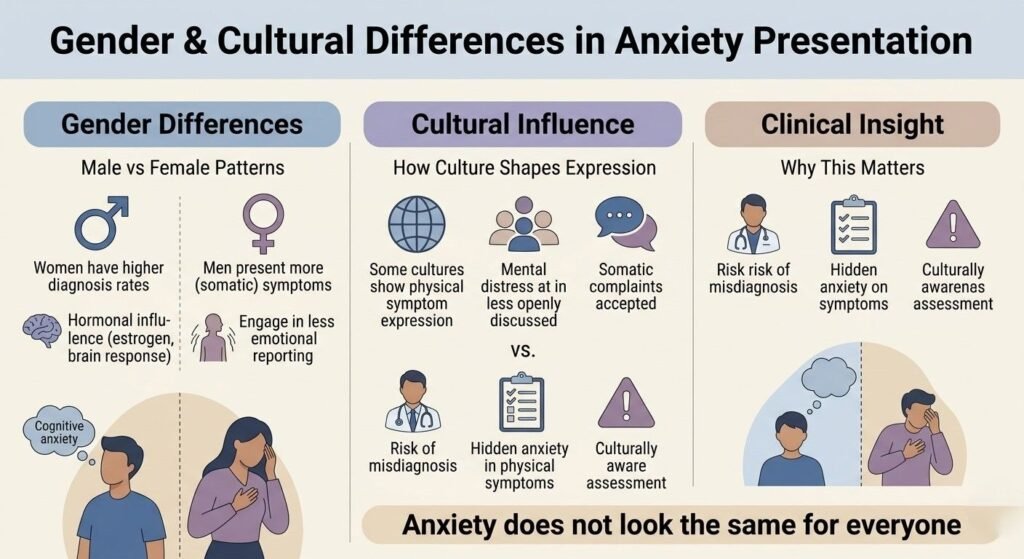
Epidemiological research reveals important demographic patterns in emotional vs cognitive anxiety presentations:
- Women are nearly twice as likely as men to be diagnosed with anxiety disorders, with research suggesting hormonal factors including estrogen’s influence on amygdala reactivity contribute to this differential
- Men are significantly more likely to present with somatic anxiety symptoms in primary care settings while underreporting emotional and psychological dimensions, leading to frequent misdiagnosis
- Cultural factors influence whether somatic or cognitive symptoms are expressed and disclosed, with some cultural contexts producing more somatized anxiety presentations due to greater cultural acceptance of physical versus psychological distress
Clinically competent assessment of emotional vs cognitive anxiety must account for these demographic and cultural variables to avoid systematic misdiagnosis.
Building Your Personalized Emotional vs Cognitive Anxiety Management Plan
Based on your dominant anxiety type, here is a practical framework for building an effective daily management approach:
For primarily cognitive anxiety:
- Morning: 10-minute mindfulness meditation to reduce DMN activation before engaging with tasks
- Throughout day: Scheduled worry time (15 minutes maximum), cognitive restructuring of catastrophic thoughts
- Evening: Expressive writing to externalize and process cognitive content before sleep
For primarily emotional anxiety:
- Morning: 5-minute diaphragmatic breathing to build parasympathetic tone before the day’s demands begin
- Throughout day: Box breathing during stress activation moments, brief PMR targeting shoulders and jaw
- Evening: Progressive muscle relaxation, cold shower, or extended exhale breathing before sleep
For mixed presentations:
- Combine elements from both frameworks, beginning with physiological regulation before cognitive intervention during acute anxiety episodes (regulate the body first, then engage the mind)
When to Seek Professional Support
Understanding emotional vs cognitive anxiety equips you with powerful self-directed tools, but professional clinical support is essential when:
- Anxiety significantly impairs work, relationships, or daily functioning
- Self-directed strategies produce minimal improvement after consistent practice
- Anxiety is accompanied by depression, trauma history, or substance use
- Panic attacks are occurring with increasing frequency or severity
- Anxiety has produced significant lifestyle restriction or avoidance
A qualified therapist specializing in anxiety can provide accurate differential assessment of your emotional vs cognitive anxiety profile and design a precisely matched treatment plan that targets your specific neurobiological presentation.
Final Thoughts
The emotional vs cognitive anxiety distinction is not a theoretical abstraction. It is a clinically actionable framework that empowers you to move beyond generic anxiety management advice toward precision-targeted interventions that actually match your brain and body’s specific anxiety architecture.
Your anxiety is not a personal failure or a character weakness. Whether it originates in a hyperactive thinking mind or an oversensitive nervous system, it is a neurobiological signal worth understanding with compassion and addressing with clinical precision. When you understand whether your anxiety starts in the mind or the body, you stop wasting energy on mismatched strategies and begin investing in interventions that work with your specific neurobiology.