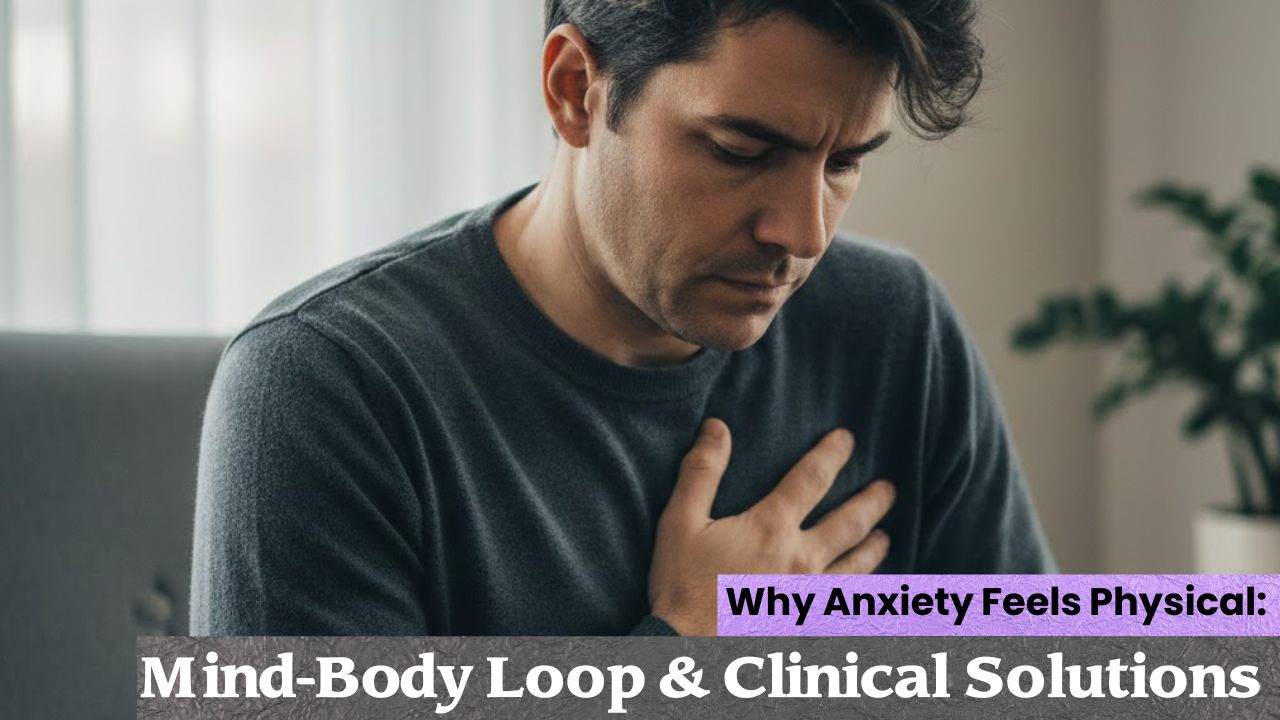
Why Anxiety Feels Physical: Mind-Body Loop & Clinical Solutions
Introduction
Your heart is thumping against your ribs not because it is failing, but because it is performing exactly as evolution intended. You’re sitting in a quiet office, perhaps scrolling through an endless Slack thread, and suddenly your chest tightens, your stomach flips, and your hands tremble. On the outside, everything seems normal, yet your body is reacting as if you were being chased by a predator across the Savannah.
This invisible experience can be terrifying. Many people dismiss it as “all in my head,” leaving them anxious about being sick or losing control. But these sensations are far from imaginary. They are the result of complex biological systems evolved to protect you. Understanding how and why anxiety manifests physically is crucial, especially in a modern world where triggers are often abstract—emails, deadlines, social scrutiny—rather than immediate physical threats.
The Modern American Stress Epidemic
Anxiety disorders are the most common mental illness in the United States, affecting approximately 40 million adults. According to the National Institute of Mental Health (NIMH), about 19.1% of U.S. adults experienced an anxiety disorder in the past year. These numbers highlight that what you are feeling is not rare; it’s part of a broader physiological and psychological pattern impacting millions.
The challenge is that chronic anxiety can keep your body in a state of heightened alertness, a phenomenon scientists refer to as allostatic load. Over time, this cumulative stress leads to wear and tear on nearly every system of the body—immune, cardiovascular, digestive, and musculoskeletal—explaining why people often develop secondary health issues alongside anxiety.
The Chemical Chain Reaction: How the HPA Axis Drives Anxiety
This YouTube video below by Air Anatomy explains the HPA axis and how the body responds to stress. It breaks down hormonal signaling and stress regulation in simple terms. This reference supports understanding the biological foundation of stress responses.
The Hypothalamic-Pituitary-Adrenal (HPA) Axis is at the center of anxiety’s physical expression. Imagine it as a chemical chain reaction, designed for the Savannah, now triggered by a Slack notification or a looming deadline.
When a stressful thought reaches your prefrontal cortex, the amygdala signals the hypothalamus. The hypothalamus releases corticotropin-releasing hormone (CRH), which prompts the pituitary gland to secrete ACTH. ACTH then instructs the adrenal glands to release cortisol, your body’s primary stress hormone. Cortisol prepares muscles, heart, and lungs for action while temporarily slowing digestion and other non-essential processes.
This system is adaptive in acute, life-threatening situations. But in modern life, where the “threats” are often symbolic—emails, social pressure, traffic jams—the same reaction can cause persistent discomfort and alarm, creating a mind-body loop where sensations fuel anxiety, and anxiety intensifies sensations.
The Gut-Brain Axis: Why Anxiety Causes Nausea and IBS
Your digestive system is not just a series of tubes—it’s a complex network known as the Enteric Nervous System (ENS), often called the “second brain.” About 95% of serotonin, a neurotransmitter influencing mood, is located in the gut. This explains why anxiety often presents first as gastrointestinal distress.
Clinical Spotlight: Consider patients misdiagnosed with Irritable Bowel Syndrome (IBS). Often, their primary issue is chronic anxiety, not a digestive disorder. The gut-brain axis communicates both ways: stress affects digestion, and digestive discomfort feeds back into the brain, amplifying anxiety. Understanding this bi-directional communication is critical for effective treatment.
Physical Symptoms and Their Evolutionary Purpose
Rather than simple lists, consider the following table to understand symptoms in an evolutionary and modern context:
| Physical Symptom | Evolutionary Purpose | Modern Reframe |
|---|---|---|
| Chest Tightness | Blood shunting to muscles for running | Practice deep breathing; tightness signals alertness, not cardiac failure |
| Racing Heart (Tachycardia) | Increases oxygen to limbs for fight-or-flight | Recognize it as context-dependent arousal, not danger |
| Nausea & Digestive Upset | Slows non-essential digestion to conserve energy | Mindful hydration and food intake can calm ENS |
| Dizziness & Air Hunger | Hyperventilation to prepare for exertion | Slow, controlled breathing restores equilibrium |
| Muscle Tension & Trembling | Stores survival energy for immediate use | Release tension through stretching or therapeutic tremoring |
Patient Scenario: “Sarah” experiences sudden dizziness while grocery shopping. Fluorescent lights, crowds, and noise trigger CO2 drops, simulating a threat. Recognizing this helps her reframe the sensation and reduce panic.
Interoception: When the Body Feels Too Much
Interoception is the brain’s awareness of internal bodily states. People with high anxiety are often hyper-aware, misinterpreting benign physical changes as danger. This is described by the Smoke Detector Principle: the brain is over-sensitive, alerting you to “fire” when there is only burnt toast.
Pro-Tip: Modern wearable devices like Apple Watches or Whoop straps, while useful, can inadvertently amplify this hyper-awareness. Constantly checking your heart rate may reinforce the mind-body loop, making mild arousal feel like an emergency.
Polyvagal Theory and the Vagus Nerve
The Vagus Nerve regulates the body’s stress response. According to Polyvagal Theory (Dr. Stephen Porges):
- Ventral Vagal: Supports social engagement, calm, and safety.
- Dorsal Vagal: Associated with shutdown or freeze responses.
Activating the ventral state through slow breathing, humming, or cold exposure signals the body that it is safe, interrupting the mind-body loop and reducing physical anxiety.
Cognitive Reframing: The Misinterpretation of Arousal
Our brains label physiological arousal differently depending on context. For example, a racing heart during a treadmill session is interpreted as normal exertion, but in a boardroom, the same signal is often labeled “panic.” Understanding this misinterpretation is central to breaking the loop, shifting perception from danger to context-appropriate alertness.
Chronic vs. Acute Anxiety: The Toll of Allostatic Load
Acute anxiety is short-term and context-specific. Chronic anxiety, however, keeps cortisol elevated, maintaining a pro-inflammatory state. Persistent pro-inflammatory cytokines contribute to chronic pain, fatigue, and autoimmune flare-ups. Recognizing the biological impact underscores why early intervention is essential.
Modern American Stress Epidemic: Chronic stress affects millions, linking anxiety to six leading causes of death in the US, including cardiovascular disease, diabetes, and stroke.
External Triggers: Caffeine, Nicotine, and Lifestyle Factors
Caffeine and nicotine mimic the fight-or-flight response by increasing adrenaline and sympathetic activation. Even moderate consumption can amplify the physical sensations of anxiety, creating unnecessary feedback loops. Awareness and moderation are important strategies for breaking the cycle.
Grounding Techniques: Clinical Spotlight
5-Step Method to Reduce Physical Anxiety
- Splash Cold Water: Stimulates the ventral vagal state to slow heart rate.
- Box Breathing: Inhale-hold-exhale-hold for four seconds to stabilize oxygen and CO2.
- Shake or Stretch Muscles: Release survival energy safely.
- Ground with Senses: Engage the 5-4-3-2-1 method to shift attention externally.
- Reframe Thoughts: Label sensations as stress responses rather than danger signals.
Conclusion
Physical anxiety is real and rooted in biology. From the HPA axis to the gut-brain connection and vagal regulation, your body reacts to perceived threats—even modern, symbolic ones. Understanding these mechanisms, recognizing triggers, and applying grounding, breathing, and cognitive reframing strategies can break the mind-body loop. With awareness and evidence-based techniques, you can calm both body and mind.