Mindful eating practices represent one of the most profound yet accessible transformations available to anyone seeking to improve their physical health, emotional wellbeing, and relationship with food simultaneously. In the relentless pace of modern life, eating has been reduced for millions of people to a hurried, distracted, guilt-laden experience disconnected from genuine nourishment, sensory pleasure, or bodily awareness.
We eat while scrolling phones, working at desks, driving between commitments, and watching television, consuming food without tasting it, fueling our bodies without honoring them, and often using food to manage emotions rather than satisfy genuine physical hunger. Mindful eating practices offer a fundamentally different relationship with food, one grounded in present-moment awareness, sensory engagement, compassionate self-observation, and a deep respect for the body’s innate wisdom.
In this comprehensive guide, we explore the science behind mindful eating practices, their documented health benefits, and exactly how to integrate them into even the busiest modern lifestyle.
 Mindful Eating Practices For Improved Health And Well-being 2">
What Are Mindful Eating Practices? A Clinical Definition
Mindful eating practices are the application of mindfulness, the intentional, non-judgmental awareness of present-moment experience, to the act of eating and all behaviors surrounding food. Rooted in Buddhist contemplative traditions and formalized as a clinical intervention by researchers including Dr. Jean Kristeller at Indiana State University, mindful eating represents a fundamentally different approach to food from both restrictive dieting and unconscious habitual eating.
The Center for Mindful Eating defines mindful eating as:
“Allowing yourself to become aware of the positive and nurturing opportunities that are available through food preparation and consumption by respecting your own inner wisdom.”
Critically, mindful eating practices are not a diet. They impose no food rules, forbidden categories, caloric restrictions, or prescribed meal plans. Instead, they cultivate the awareness, attentional skills, and self-compassion needed to make food choices that genuinely honor both physical nourishment and authentic psychological satisfaction.
This YouTube video below by Stanford Health Care explains mindful eating in under ten minutes. It covers paying attention to hunger cues, taste, and eating habits. This reference supports healthier relationships with food and improved eating awareness.
The Distinction Between Mindful Eating and Intuitive Eating
While closely related, mindful eating practices and intuitive eating are distinct frameworks that complement rather than duplicate one another:
Mindful eating practices focus primarily on the quality of present-moment awareness during the eating experience itself, including sensory engagement, hunger and satiety recognition, and non-judgmental observation of thoughts and emotions related to food.
Intuitive eating is a broader behavioral framework developed by dietitians Evelyn Tribole and Elyse Resch that addresses the full relationship with food including rejection of diet culture, body respect, and movement. Mindful eating practices form a core component of intuitive eating but extend beyond it into moment-to-moment sensory awareness during eating itself.
The Neuroscience and Psychology Behind Mindful Eating Practices
Understanding why mindful eating practices work at the neurobiological level deepens motivation and helps practitioners apply techniques more effectively and consistently.
The Gut-Brain Axis and Mindful Eating
The gastrointestinal system and the brain are connected through a sophisticated bidirectional communication network known as the gut-brain axis, which includes the vagus nerve, enteric nervous system, and a complex ecosystem of neurotransmitters and hormones. This system governs hunger, satiety, digestive efficiency, and even mood regulation.
When eating occurs in a stressed, distracted, or hurried state, the sympathetic nervous system (fight-or-flight) dominates, actively suppressing digestive function, reducing gastric acid production, slowing intestinal motility, and impairing nutrient absorption. This is why chronic stressed eating contributes to digestive disorders including irritable bowel syndrome, bloating, and functional dyspepsia.
Mindful eating practices activate the parasympathetic nervous system (rest-and-digest), which optimizes the full digestive cascade: stimulating salivary enzyme production, normalizing gastric acid secretion, improving intestinal motility, and enhancing nutrient absorption efficiency. Simply eating slowly, calmly, and with full sensory attention measurably improves the body’s ability to extract nourishment from food.
Hormonal Regulation Through Mindful Eating Practices
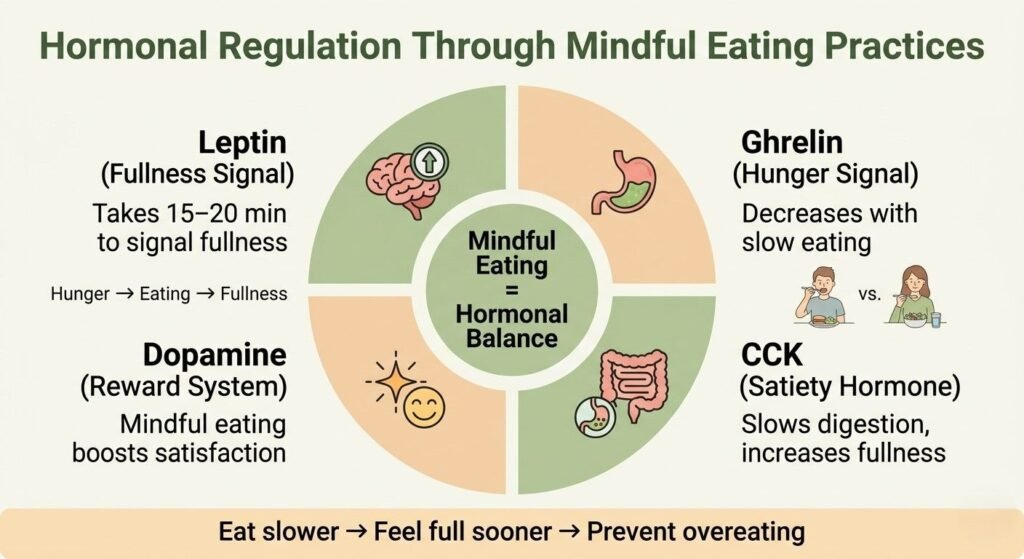
The hormonal systems governing hunger and satiety are profoundly sensitive to the speed and attentiveness with which eating occurs:
Leptin: The satiety hormone released by fat cells to signal fullness to the hypothalamus. Leptin signaling requires approximately 15 to 20 minutes of eating to reach the brain with full effect. When eating occurs rapidly, as in most distracted or rushed meals, the meal is often complete before leptin signals have communicated genuine fullness, contributing to systematic overconsumption.
Ghrelin: The primary hunger hormone, secreted by the stomach and suppressed by eating. Mindful eating practices that include slowing the pace of eating allow ghrelin suppression to occur in real time, reducing the urge to continue eating past genuine satiety.
Cholecystokinin (CCK): Released by the small intestine in response to protein and fat, CCK produces satiety signals and slows gastric emptying. Thorough chewing and slower eating pace optimize CCK release timing.
Dopamine: Released in anticipation of eating and during the early pleasurable phases of food consumption. Mindful eating practices that maximize sensory engagement, particularly the savoring of flavor, texture, and aroma, optimize the dopamine reward response from smaller quantities of food, reducing the reward-seeking drive that contributes to overeating.
The Role of Interoception in Mindful Eating Practices
Interoception is the brain’s ability to perceive and accurately interpret signals arising from within the body, including hunger, satiety, thirst, digestive discomfort, and emotional states. Research consistently demonstrates that individuals with eating disorders, emotional eating patterns, and disordered relationships with food show impaired interoceptive accuracy, an inability to reliably distinguish genuine physical hunger from emotional hunger, boredom, stress, or habitual eating cues.
Mindful eating practices systematically develop interoceptive accuracy by repeatedly directing deliberate, curious attention toward internal body signals without judgment or reactive response. Over time, this training rebuilds the brain’s ability to accurately read and trust the body’s genuine nutritional signals rather than responding to external cues, emotional states, or habitual patterns.
10 Core Mindful Eating Practices for Improved Health and Well-Being
1. Cultivate Hunger and Satiety Awareness
The foundational mindful eating practice is developing accurate, nuanced awareness of your body’s genuine hunger and fullness signals before, during, and after eating. Most adults in diet culture and stressed modern life have become profoundly disconnected from these innate biological signals, eating by the clock, social convention, emotional state, or food availability rather than genuine physical need.
The Hunger-Fullness Scale Practice:
Before eating, pause and honestly assess your current hunger level on a 1 to 10 scale where 1 represents extreme, painful hunger and 10 represents painfully overfull. Ideally, begin eating at approximately 3 to 4 (genuinely hungry but not ravenous) and stop at approximately 6 to 7 (comfortably satisfied but not full).
During eating, pause mid-meal and reassess. This single practice, pausing to check in with genuine fullness, is one of the most powerful mindful eating practices for preventing unconscious overconsumption.
Distinguishing Physical from Emotional Hunger:
Physical hunger develops gradually, can be satisfied by any food, is felt in the stomach, and diminishes with eating. Emotional hunger arises suddenly, craves specific comfort foods, is felt in the mind and mouth rather than the stomach, and persists after eating because its true source is emotional rather than nutritional. Developing the ability to accurately distinguish these is a central goal of mindful eating practices.
2. Engage All Five Senses Before and During Eating
Full sensory engagement is one of the most pleasurable and neurobiologically important mindful eating practices. Before taking the first bite, take thirty seconds to genuinely observe your food: notice its colors, textures, aromas, and presentation. This pre-eating observation activates the cephalic phase digestive response, a neurobiological process triggered by sensory engagement with food that stimulates salivary enzyme production, gastric acid secretion, and insulin preparation before food even enters the mouth.
During eating, deliberately engage each sense:
- Sight: Notice the visual complexity of your food, colors, textures, and how it changes as you eat
- Smell: Inhale the aromas before each bite and notice how scent amplifies flavor experience
- Touch: Notice the texture of food in your mouth, smooth, crunchy, chewy, tender
- Sound: Notice the sounds of chewing, which can enhance sensory engagement and slow the eating pace
- Taste: Identify primary tastes (sweet, salty, sour, bitter, umami) and how they evolve across the duration of each bite
Research demonstrates that increased sensory engagement during eating produces greater meal satisfaction from smaller food quantities, directly supporting mindful eating practices as a sustainable approach to portion moderation without restriction.
3. Eliminate Eating Distractions Deliberately
Eating while distracted is one of the most pervasive and consequential eating patterns in modern culture. Research consistently demonstrates that screen-based distraction during meals:
- Reduces meal satisfaction and sensory pleasure
- Impairs hunger and satiety signal recognition
- Increases total caloric consumption by 10 to 25 percent
- Promotes continued snacking after meals due to reduced memory encoding of the eating experience
One of the most impactful mindful eating practices you can implement immediately is creating a dedicated eating space free from screens, work materials, and electronic devices. This does not require every meal to be a formal, extended mindful eating ceremony. Even a five-minute distraction-free eating practice during a brief lunch break produces measurable improvements in satiety recognition and meal satisfaction compared to screen-based eating.
Single-tasking eating practice: For at least one meal per day, eat with no other activity occurring simultaneously. Sit at a table, place your phone face-down or in another room, and give the meal your complete, undivided attention.
4. Practice Deliberate Slow Eating and Thorough Chewing
The pace of eating is one of the most powerful modifiable variables in the relationship between mindful eating practices and health outcomes. Research published in the British Medical Journal found that self-reported fast eaters were significantly more likely to be overweight or obese than slow eaters, independent of food choices, demonstrating that eating speed itself is a meaningful metabolic variable.
Thorough chewing serves multiple simultaneous functions that make it one of the most physiologically important mindful eating practices:
- Mechanical digestion: Thorough chewing breaks food into smaller particles, dramatically increasing the surface area available for enzymatic digestion and improving nutrient extraction efficiency
- Salivary amylase activation: Extended chewing mixes food thoroughly with salivary amylase, beginning carbohydrate digestion in the mouth
- Satiety hormone timing: Slower eating allows leptin, CCK, and other satiety hormones adequate time to communicate fullness to the brain before overconsumption occurs
Practical implementation: Place utensils down between each bite. Chew each bite 20 to 30 times before swallowing. Notice how this single mindful eating practice transforms the sensory experience of eating and produces genuine fullness from smaller meal portions over time.
5. Cultivate a Pre-Meal Gratitude Ritual
A brief pre-meal gratitude practice is one of the simplest yet most neurobiologically meaningful mindful eating practices for establishing the psychological conditions necessary for genuinely nourishing eating. Before beginning each meal, take 30 to 60 seconds to acknowledge the food before you with genuine appreciation.
This practice works through several mechanisms:
Parasympathetic activation: Pausing and cultivating positive emotion before eating activates the parasympathetic rest-and-digest response, optimizing the digestive environment before food is consumed.
Positive affect and food relationship: Research demonstrates that positive emotional states during eating improve the subjective experience of food, reduce the likelihood of guilt-driven emotional eating patterns, and support healthy dietary choices.
Mindful transition signaling: The gratitude ritual functions as a clear psychological transition signal, communicating to the nervous system that the eating experience is beginning and that distracted or hurried consuming is shifting into nourishing, present-moment engagement.
6. Practice Mindful Snacking with the Same Attention as Meals
One of the most overlooked mindful eating practices is extending the same quality of awareness to snacking that we aspire to bring to formal meals. Snacking, particularly habitual, distracted, or emotionally triggered snacking, represents one of the primary contexts in which the disconnect between physical hunger and eating behavior is most pronounced.
Mindful snacking protocol:
- Before snacking, pause and honestly assess whether genuine physical hunger is present or whether the urge to snack is driven by boredom, stress, habit, or emotional discomfort
- If hunger is genuine, choose a snack that genuinely appeals to you rather than defaulting to habitual choices
- Serve the snack on a plate or bowl rather than eating directly from a package, which eliminates visual portion cues
- Eat the snack sitting down with full sensory attention, exactly as you would approach a formal meal
7. Explore Mindful Grocery Shopping and Meal Preparation
Mindful eating practices extend beyond the table to encompass the full food journey from selection to preparation. Mindful grocery shopping involves approaching the market with genuine intentionality, selecting whole, minimally processed foods with curious sensory engagement, noticing colors and freshness, reading ingredient lists with awareness, and choosing foods that reflect genuine nourishing intention rather than reactive habitual selection.
Mindful meal preparation transforms cooking from a chore into a contemplative mindful eating practice in its own right. Engaging all senses during food preparation, noticing colors, aromas, textures, and sounds of cooking, creates a sensory relationship with your food before it is consumed that primes the body’s digestive readiness and deepens appreciation for the nourishment being created.
Research suggests that individuals who prepare their own food regularly demonstrate healthier dietary patterns, greater dietary variety, and stronger food satisfaction compared to those who primarily consume prepared or processed foods, with mindful cooking contributing meaningfully to these outcomes.
8. Apply Mindful Eating Practices in Social Eating Contexts
Social eating, shared meals with family, friends, colleagues, or in restaurant settings, presents both unique opportunities and specific challenges for mindful eating practices. The social context can support mindful eating through the natural slowing of pace that conversation produces between bites, the positive emotional environment of connection and shared pleasure, and the cultural ritual significance of communal nourishment.
Conversely, social eating can undermine mindful eating practices through social pressure to eat particular foods or quantities, distraction from internal hunger and satiety signals by social engagement, and the emotional complexity that family food dynamics can introduce.
Mindful social eating strategies:
- Use conversation pauses to check in briefly with genuine hunger and fullness rather than eating continuously between conversational exchanges
- Practice the mindful eating practice of placing utensils down during conversation, naturally slowing eating pace
- Give yourself explicit permission to leave food on the plate when genuine satiety is reached, regardless of social convention around finishing what is served
- Engage in genuine sensory appreciation of restaurant meals rather than distracted or hurried consumption
9. Address Emotional Eating Through Mindful Awareness
Emotional eating, using food to manage uncomfortable emotions including stress, anxiety, loneliness, boredom, and sadness, is one of the most common and clinically significant disruptions of healthy food relationships. Mindful eating practices provide the awareness and self-compassion framework needed to recognize emotional eating patterns and develop alternative emotional regulation strategies.
The STOP technique for emotional eating:
- S: Stop before eating and pause deliberately
- T: Take three slow, deep breaths, activating the parasympathetic nervous system
- O: Observe what is actually happening emotionally. Name the specific emotion present: “I feel anxious about the meeting tomorrow” rather than “I feel like eating”
- P: Proceed with genuine choice, either eating mindfully if physical hunger is present, or addressing the emotional need directly through an alternative regulation strategy such as movement, breathing, social connection, or journaling
Research from Dr. Jean Kristeller’s Mindfulness-Based Eating Awareness Training (MB-EAT) program demonstrates that structured mindful eating practices significantly reduce binge eating episodes, emotional eating frequency, and eating disorder symptom severity in clinical populations.
10. Cultivate Non-Judgmental Awareness of Food Choices
Perhaps the most psychologically transformative of all mindful eating practices is the cultivation of genuinely non-judgmental awareness of food choices, eating experiences, and bodily responses. Diet culture has deeply conditioned most people to experience food through a constant lens of moral evaluation, “good” and “bad” foods, “clean” and “cheat” eating, virtue and failure.
This judgment-saturated relationship with food produces shame, guilt, anxiety, and ultimately contributes to the disordered eating patterns it claims to prevent. Mindful eating practices deliberately cultivate a different quality of awareness: curious, compassionate, non-evaluative observation of the full eating experience without moral labeling.
Practical non-judgment cultivation:
After eating, observe your thoughts about what you ate without amplifying or suppressing them. If self-critical thoughts arise, practice observing them as thoughts rather than facts: “I notice I am having the thought that I ate badly” rather than “I ate badly and that means something about my worth.” This subtle but profound shift is the foundation of a sustainable, genuinely healthy relationship with food that mindful eating practices cultivate over time.
The Evidence Base for Mindful Eating Practices: What Research Demonstrates
The clinical research supporting mindful eating practices has expanded substantially over the past two decades:
- A 2018 systematic review published in Obesity Reviews found that mindful eating interventions consistently produced significant reductions in binge eating, emotional eating, and eating disorder psychopathology across diverse clinical populations
- Research by Dr. Jean Kristeller demonstrates that MB-EAT (Mindfulness-Based Eating Awareness Training) reduced binge eating episodes from an average of four per week to fewer than two per week in clinical trials
- A 2019 meta-analysis in Nutrients found that mindful eating practices produced meaningful improvements in dietary quality, body weight, and psychological wellbeing independent of specific dietary composition
- Studies consistently demonstrate that mindful eating practices improve blood glucose regulation in individuals with Type 2 diabetes through improved meal timing, composition awareness, and stress-related eating reduction
- Research on gut-brain axis function demonstrates that parasympathetic-dominant eating states produced by mindful eating practices measurably improve digestive enzyme activity, gastric motility, and nutrient absorption efficiency
Integrating Mindful Eating Practices with Mental Health Support
The relationship between mindful eating practices and mental health is bidirectional and clinically significant. Anxiety and depression frequently disrupt eating patterns through stress-related appetite suppression, emotional eating, and the cognitive preoccupation that impairs present-moment meal awareness. Conversely, disrupted eating patterns worsen mood, energy, cognitive function, and emotional regulation capacity.
Integrating mindful eating practices within a broader mental health support context, including therapy, Stress Management specialists in Houston" class="pseo-auto-link">stress management, and emotional regulation skill development, produces significantly stronger outcomes than either approach in isolation. A therapist specializing in the intersection of mental health and eating behavior can provide personalized guidance on developing mindful eating practices specifically tailored to your unique psychological history and relationship with food.
Frequently Asked Questions About Mindful Eating Practices
Can mindful eating practices support healthy weight management?
Yes. Research consistently demonstrates that mindful eating practices improve awareness of genuine hunger and satiety signals, reduce emotionally triggered eating, and increase meal satisfaction from appropriate portions, collectively supporting healthy, sustainable weight management without restrictive dieting.
How long before mindful eating practices produce noticeable results?
Many people notice improvements in meal satisfaction, digestive comfort, and eating awareness within one to two weeks of consistent practice. Deeper changes in emotional eating patterns and food relationship quality typically emerge over two to three months of regular mindful eating practice.
Can mindful eating practices benefit children?
Absolutely. Age-appropriate mindful eating practices support children’s development of healthy food relationships, body awareness, and intuitive eating capacities from an early age, potentially preventing the development of disordered eating patterns later in life.
Are mindful eating practices compatible with specific therapeutic diets?
Yes. Mindful eating practices are inherently compatible with any dietary approach because they are about the quality of awareness during eating rather than the specific content of what is eaten. They can meaningfully enhance the experience and sustainability of any medically or nutritionally indicated dietary pattern.
What if I struggle with consistent mindful eating practice?
Inconsistency is normal and expected, particularly during periods of high stress. Self-compassion is itself a core mindful eating practice. When you notice inconsistency, bring the same non-judgmental awareness to your relationship with the practice itself that you are cultivating toward food.
Final Thoughts
Mindful eating practices are not a dietary intervention, a weight management strategy, or a wellness trend. They are a fundamental reorientation of your relationship with food, body, and self, from disconnected, hurried, and judgment-saturated consuming to present-moment, sensory-rich, compassionate nourishment.
When you bring genuine mindful attention to eating, you do not simply change what you eat or how much you eat. You change who you are in relationship to food, developing the awareness, self-compassion, and bodily wisdom needed to nourish yourself in ways that genuinely support your physical health, emotional wellbeing, and the profound pleasure that food, approached with presence and gratitude, is designed to provide.
Begin with one mindful eating practice from this guide. Practice it consistently for one week. Notice what shifts. Build gradually from there, with patience, curiosity, and the same gentle, non-judgmental awareness that is the heart of mindful eating itself.