
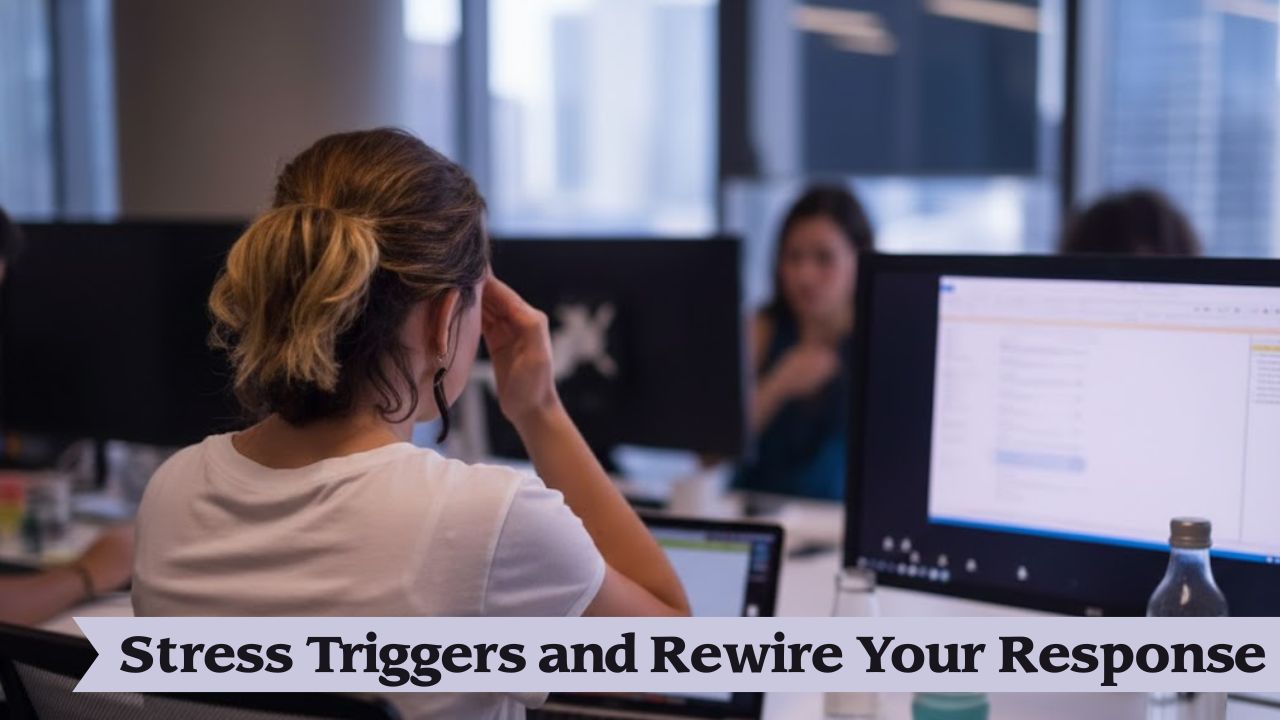
How to Identify Your Stress Triggers and Rewire Your Response
The Stimulus-Response Trap: Why You Feel Out of Control
You’re stuck in traffic. Your heart races, palms sweat, and your mind spirals. Is it the traffic stressing you? Not exactly. The traffic is a trigger; your pounding heart and shallow breathing are the stress response.
In the US, professionals face the Agency Gap: feeling that stress happens to them, not something they can influence. Nearly 27% of US adults report being so stressed they cannot function on most days (APA Stress in America report). Recognizing the difference between triggers and responses is your first step to regaining control.
Stress isn’t the event—it’s your reaction. The milliseconds between trigger and response are your window to intervene.
Window of Tolerance: Staying Online Under Stress
This YouTube video below by Therapy in a Nutshell explains the Window of Tolerance as a core skill for trauma and PTSD recovery. It shows how staying within this zone supports emotional regulation. This reference reinforces practical strategies for managing stress responses.
Dr. Dan Siegel’s Window of Tolerance explains why triggers push us into Hyper-arousal (anxiety, anger) or Hypo-arousal (numbness, freezing). The goal isn’t to eliminate stress but to widen this window, keeping the Prefrontal Cortex “online” for rational, deliberate choice.
Somatic Tracking
When in the Window of Tolerance, you can observe a racing heart or tense muscles without reacting. This “Objective Observer” stance allows you to notice sensations, acknowledge them, and prevent escalation.
Widening your Window of Tolerance is the key to breaking cycles before they spiral.
Audit Your Triggers: Inputs That Prime Your Stress
Stress triggers are both external and internal, obvious or subtle. Identifying them gives you leverage to intervene early.
Types of Triggers
1. Emotional Triggers
- Criticism, judgment, or interpersonal conflict.
- Internal distortions like Mind Reading (assuming others’ thoughts) or Catastrophizing (assuming the worst).
2. Situational Triggers
- Deadlines, traffic, financial stress.
- Micro-stressors common in US workplaces: unexpected Zoom calls, rapid-fire emails, or tight project sprints.
3. Sensory Triggers
- Noise, blue light, or cluttered environments.
- These prime the Limbic System, making Amygdala Hijacks more likely.
Self-Audit: The Trigger Journal
- Record events, thoughts, and physical responses.
- Patterns emerge, helping predict and interrupt stress reactions.
Awareness of triggers—emotional, situational, and sensory—is your first step to control.
Decode Your Response: Physical and Psychological Outputs
Your stress response is the body and mind reacting to triggers. Understanding it allows targeted intervention.
Physical Responses
- Muscle tension, shallow breathing, increased heart rate.
- Digestive slowdown, headaches, fatigue.
Psychological Responses
- Cognitive Tunneling: focus narrows, increasing Working Memory load.
- Catastrophizing, withdrawal, and Moralizing Productivity: guilt for “not doing enough.”
Feedback Loops
- Physical reactions can reinforce stress. Shaking hands in a meeting can spark fear of judgment—a secondary trigger.
Recognizing responses early allows you to break the chain before escalation.
How to Break the Stress Cycle: The Science of the Pattern Interrupt
The Pattern Interrupt is the millisecond window after a trigger where you can stop escalation.
The 90-Second Rule
- Emotional reactions, driven by Cortisol and Adrenaline, take ~90 seconds to metabolize.
- Beyond this, lingering stress is self-induced rumination.
Top-Down Intervention
- Engage the Prefrontal Cortex: label the emotion (“I am feeling triggered right now”).
- Cognitive reframing helps reason override limbic reactivity.
Bottom-Up Intervention
- Ground using Proprioception or Interoception: feel your feet, notice posture.
- Activates the Vagus Nerve and the Autonomic Nervous System (ANS), calming the sympathetic branch and restoring parasympathetic dominance.
Use the 90-Second Rule with Top-Down labeling and Bottom-Up grounding to prevent a trigger from turning into chronic stress.
Quick-Start Table: Rewire Toolkit
| Category | The Drain | The Fix |
|---|---|---|
| Mindset | Hyperarousal / Hypo-arousal | Label the emotion (Top-Down) |
| Body | Sympathetic dominance | Vagal breathing, Proprioceptive grounding |
| Environment | Sensory overload / Digital Debris | Visual Silence, remove unnecessary stimuli |
| Resilience | Low Stress Threshold / Decision Fatigue | Sleep, boundaries, and controlled choice architecture |
Structural Solutions: Building Resilience
Decision Fatigue and the Always-On Culture
- US remote and hybrid work blends office and home. Constant notifications erode cognitive boundaries, lowering your Stress Threshold.
- Evening Amygdala Hijacks are common due to accumulated decision fatigue.
Neuroplastic Rewiring
- Repeatedly choosing new responses strengthens Prefrontal Cortex control, reducing Amygdala Hijacks over time.
Heart Rate Variability (HRV)
- Higher HRV indicates a wider Window of Tolerance and better ANS flexibility.
- Trackable with wearables like Oura, Whoop, or Apple Watch.
Allostatic Overload
- Chronic exposure without recovery leads to Allostatic Overload, increasing risk for systemic health issues.
Structural solutions—sleep, boundaries, HRV tracking, and neuroplastic practice—raise resilience against stress triggers.
How Do You Break the Stress Cycle?
This YouTube video below by Penguin Books UK explains burnout and how completing the stress cycle restores balance. It explores why stress persists even after problems end. This reference supports practical approaches to long-term stress recovery and resilience.
1. Identify the External Trigger
2. Observe the Somatic Response
3. Apply the 90-Second Pattern Interrupt
4. Engage Top-Down Labeling
5. Build Structural Resilience (sleep, boundaries, HRV tracking)
The Transformative Response Audit
Ask yourself: If your stress response was a person, what would it be trying to protect you from?
- This Response Audit connects physiology to psychological needs, creating actionable insights beyond just logging triggers.
The 48-Hour Response Challenge: For two days, record triggers, responses, and apply one Pattern Interrupt per event. Observe changes in reactivity and emotional clarity.